
How to Treat Life-Threatening Blood Loss
In this article we will examine the use of Israeli / Emergency bandages, tourniquets and haemostatic /clotting bandages.
Uncontrolled/uncontrollable bleeding is the most preventable cause of deaths on both the battlefield and the streets. Studies show up to 50% of combat fatalities and 39% of civilian trauma fatalities are due to uncontrolled bleeding from an extremity. It is possible to die from femoral arterial bleeding in as little as three minutes.
1. What is a Tourniquet and how is it used?

A tourniquet is a compressing device used to control venous and arterial bleeds to an extremity for a period of time. The tourniquet is usually applied when the patient is in a life-threatening state as a result of continuous bleeding.
A very primitive tourniquet can be made from a stick and a rope! The rope is made into a loop that fits over the damaged limb and the stick is inserted through the loop. Twisting the stick tightens the loop. This primitive device may stop the flow of blood but side effects may well be tissue and nerve damage. In modern medicine, pre-assembled devices have been developed and are readily available.
After World War II, the US military reduced use of the tourniquet because the time between application and reaching medical attention was so long that the damage from stopped circulation was worse than that from blood loss. Many people lost limbs but this is unlikely today as transport to hospital is much quicker through better triage protocols and the increased use of air ambulances. The modern CAT tourniquet is also much easier to use and therefore more effective.
More recently, experience in treatment of patients in civilian attacks such as the Boston Marathon bombing and combat in Iraq and Afghanistan has changed the view. In recent years there have been significant advancements in tourniquets. These advancements have vastly improved tourniquet safety. Analysis has shown that in cases of major limb trauma, there is no apparent link between tourniquet application and morbidity of the limb.
The Combat/Self-Applied Tourniquet (CAT)
The Combat Application Tourniquet (C-A-T) utilises a windlass type tightening mechanism and securing tab that can be self-applied.
Wrap the tourniquet around the limb about 10cm/4″ above the wound. Secure it tightly with the velcro strapping.
Turn the ‘windlass’ plastic stick around until the bleeding stops and tuck it under the ‘wings’.
How tight do you wind a tourniquet? Until the bleeding stops. This may result in a significant difference between the level of the tourniquet and the surrounding limb.
Write the time that the tourniquet was applied on the white tab. If you can’t write on the tab, write on the casualty! T = time in 24hr time. Always mention the tourniquet when you call 999.
Monitor your casualty for shock and check for other injuries.
2. Emergency or Israeli bandages
The Emergency Bandage or Israeli bandage is a first-aid device that is used to stop bleeding from traumatic injuries. First used for saving lives during a NATO peacekeeping operation in Bosnia and Herzegovina, the emergency bandages were nicknamed “Israeli bandage” by American soldiers. The bandage was invented by an Israeli military medic, Bernard Bar-Natan.
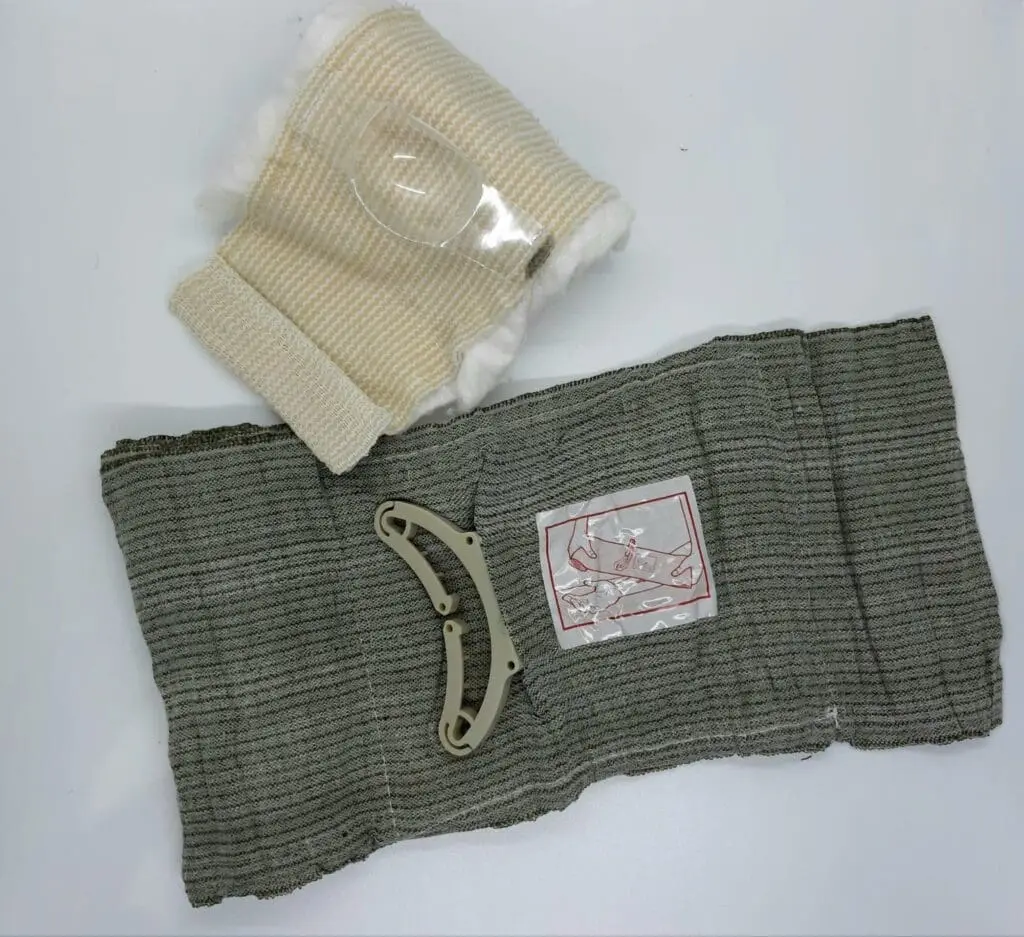
The emergency bandage is a broad elasticised bandage with a non-adhesive bandage pad sewn in. The bandage has a built-in pressure bar, which allows the user to twist the bandage around the wound once, and then change the direction of the bandage, wrapping it around the limb or body part, to create further effective pressure on the wound. Other versions have a ‘bubble’ that exerts point pressure on a wound from a bullet or stabbing injury.
The sterile non-adhering dressing that is designed to allow removing the bandage without reopening a wound. There is also space at the rear of the large dressing to add more bandages or other suitable material to soak up more blood.
Emergency bandages are quick and easy to apply and the pressure can also be easily adjusted. They are usually secured with velcro strips.
3. Haemostatic agents and dressings
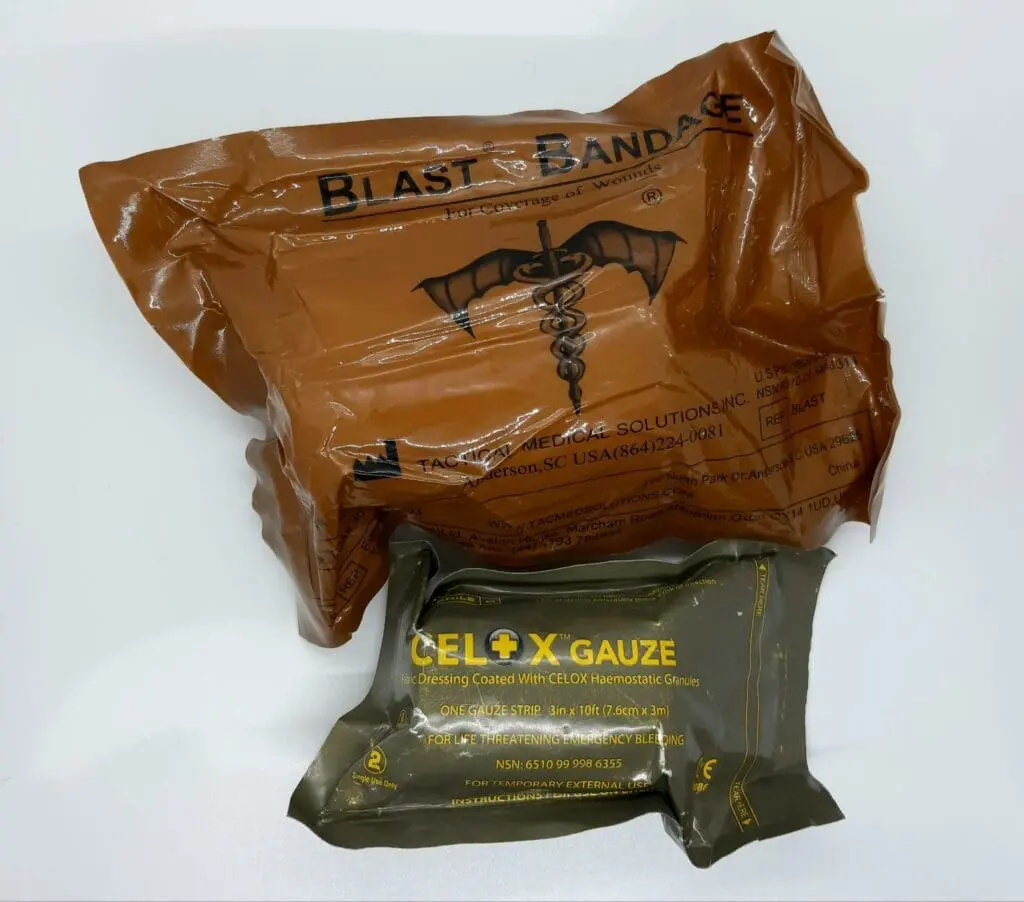
Haemostatics are designed to stem blood-flow through the accelerated promotion of clotting. As with all treatments it is important to understand their roles, applications and the differences between them.
The primary treatment for all serious bleeds is direct pressure; all haemostatics are designed to be used with direct pressure at the site of the bleed – directly onto the bleeding artery, deep within the wound if necessary. They are not a ‘magic powder’ that can be casually applied somewhere near the wound and left to work.
Haemostatics have improved since they were first produced and allow for quicker bleeding control in the field but also quicker processing through A&E because they stop the bleeding, prevent infection, can be ex-rayed and are easily removed in hospital.
Most brands of haemostatics available as either a loose, granular powder, impregnated onto a bandage or retained inside a porous bag. Powders cannot be applied against gravity – for example packing a wound underneath a casualty – nor can they be applied against very fast flowing blood. Haemostatic bandages, gauze’s and ‘sponges’ are often easier and more practical to apply. These dressings are also easier to remove and clean in theatre, once the casualty gets to hospital.
Considerations when using haemostatics:
- Haemostatics are not the first line treatment for serious bleeds. Always start with direct pressure before considering haemostatics.
- They are used with direct pressure – not instead of it.
- Every haemostatic agent (brand and type) is different and familiarisation training should be sought. Manufacturers websites are useful.
- They are applied directly to the source of the bleed – the damaged blood vessel – not somewhere near it.
- The packaging should be retained and handed-over to the EMS with the instruction that it goes with them to hospital to enable their wound to be managed effectively. Do not assume the hospital will know how to deal with the haemostatic you have applied.
- The tourniquet is an effective means of bleeding control but junctional zones, such as the groin, armpit, neck, as well as head and abdomen are unsuitable wounds for tourniquet application and difficult to maintain effective compression.
- Haemostatic agents should never be allowed to enter – eyes, airway, chest, head injuries with exposed brain tissue.
- Haemostatics should not be left in place for more than 24 hours. If the casualty cannot be evacuated to definitive care within this time, their use is not appropriate. This might limit their use in extremely remote environments.
- Haemostatics are vacuum packed which means they have a longer shelf life than other bandages.
- Always wear gloves when dealing with haemostatic products.
Do I need these big bleed products in my first aid kit?
- If you are considering buying these products, do you research and your risk assessments first. They are not cheap but they are life savers.
- And remember, pressure around the injury is key to the success of all of these products.
Get First Aid confident – get trained!
We cover medical emergencies on our range of first aid courses. Our systematic approach to teaching first aid helps your learning and understanding of many illnesses and injuries. Practicing first aid techniques reinforces your learning too. Find our more about our full range of First Aid Courses here.
Every client on our courses receives a FREE Digital First Aid Manual relevant to the course they come on. You can also view and buy our manuals in our online shop. In addition, we have our own YouTube channel with over 40 practical first aid videos so you can keep your first aid skills refreshed.